Event, Metaphor, Memory: Chauri Chaura, 1922-1992 by Shahid Amin
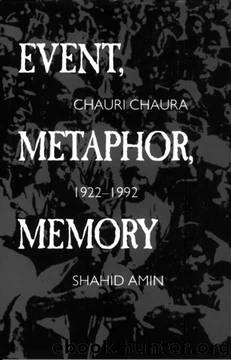
Author:Shahid Amin [Amin, Shahid]
Language: eng
Format: epub
Published: 2010-05-20T19:48:00+00:00
illage solidarity is important within the successful denouement of the Madanpur narrative. In Dumri, the story is altogether different. Here it is said that the village was deserted (ek chirai ke put ndhin rahal) and Shikari had turned approver. There is no question of police officers parleying with village elders: Dumri felt the full impact of police raids.
From the court records we know the following sequence. Shikari makes a confession on 16 March; Chotki Dumri is again raided early next morning; eighteen people are arrested and packed off to the district jail.42 Sita Ahir recalls the raid (chapa) of 17 March as follows:
A month after the riot, when people had started coming back to the village, there was a big raid. They surrounded the village from all sides. Whoever ventured out-in the middle of the night, or at dawn, even to shit-was nabbed by the police.
According to Sita, cannons had been brought over to blow Dumri up, but a legal luminary made an ingenious plea which saved the village from utter destruction.
They had brought cannons with them. Madan Mohan Malaviya sahab then argued [bahas karlan]: `Sir', he said, `four-legged animals have not burnt the thana, cows-and-buffaloes have not burnt the thana, birds have not burnt the thana. It is the two-legged creatures, men [du-gora: manhi] who have burnt the thana. Catch them! ... If you fire the top [cannon] then all l ife-chiral-chirau, goru-bachru-will be destroyed.' With this the English agreed; the cannons were not fired.
How are we to read this amazing account of Dumri's success in surviving the wrath of the avenging colonial force? There was no way in which Malaviya, a veteran nationalist, could have pleaded with the police: bahas (argument) is reserved for the courtroom, and the Allahabad pleader did not set foot in Gorakhpur till July 1922. But Malaviya had been in touch with the events of Chauri Chaura almost immediately after 4 February. His son toured Chauri Chaura as a member of a fact-finding team, and K.N. Malaviya was Counsel for the Defence in the sessions court.
The convicted rioters were defended in the High Court by a team of five lawyers, paid for by the state: the peasants convicted, as we saw, were too poor to afford their fees.43 Madan Mohan Malaviya was an additional counsel and argued on a substantial point of law. His plea was that no offence of a criminal conspiracy had been committed at the Dumri meeting on the morning of 4 February 1922, and that whatever offence was committed at the police station in the afternoon could not fairly be regarded as 'committed in the same transaction'. There had therefore been a misjoinder and conflation of charges 'sufficient to invalidate the entire trial' in the lower court.44 The High Court judges refused to accept this plea, and, when they reduced the sentences, did so on grounds of attenuating circumstances. This led them to look favourably at most of the accused, apart from the ring leaders.
For Sita, though, it was Malaviya
Download
This site does not store any files on its server. We only index and link to content provided by other sites. Please contact the content providers to delete copyright contents if any and email us, we'll remove relevant links or contents immediately.
| Anthropology | Archaeology |
| Philosophy | Politics & Government |
| Social Sciences | Sociology |
| Women's Studies |
Cecilia; Or, Memoirs of an Heiress — Volume 1 by Fanny Burney(32558)
The Great Music City by Andrea Baker(32019)
Cecilia; Or, Memoirs of an Heiress — Volume 2 by Fanny Burney(31956)
Cecilia; Or, Memoirs of an Heiress — Volume 3 by Fanny Burney(31942)
We're Going to Need More Wine by Gabrielle Union(19046)
All the Missing Girls by Megan Miranda(16028)
Pimp by Iceberg Slim(14507)
For the Love of Europe by Rick Steves(14121)
Bombshells: Glamour Girls of a Lifetime by Sullivan Steve(14075)
Talking to Strangers by Malcolm Gladwell(13370)
Norse Mythology by Gaiman Neil(13365)
Fifty Shades Freed by E L James(13241)
Mindhunter: Inside the FBI's Elite Serial Crime Unit by John E. Douglas & Mark Olshaker(9343)
Crazy Rich Asians by Kevin Kwan(9292)
The Lost Art of Listening by Michael P. Nichols(7506)
Enlightenment Now: The Case for Reason, Science, Humanism, and Progress by Steven Pinker(7313)
The Four Agreements by Don Miguel Ruiz(6765)
Bad Blood by John Carreyrou(6621)
Weapons of Math Destruction by Cathy O'Neil(6280)
